
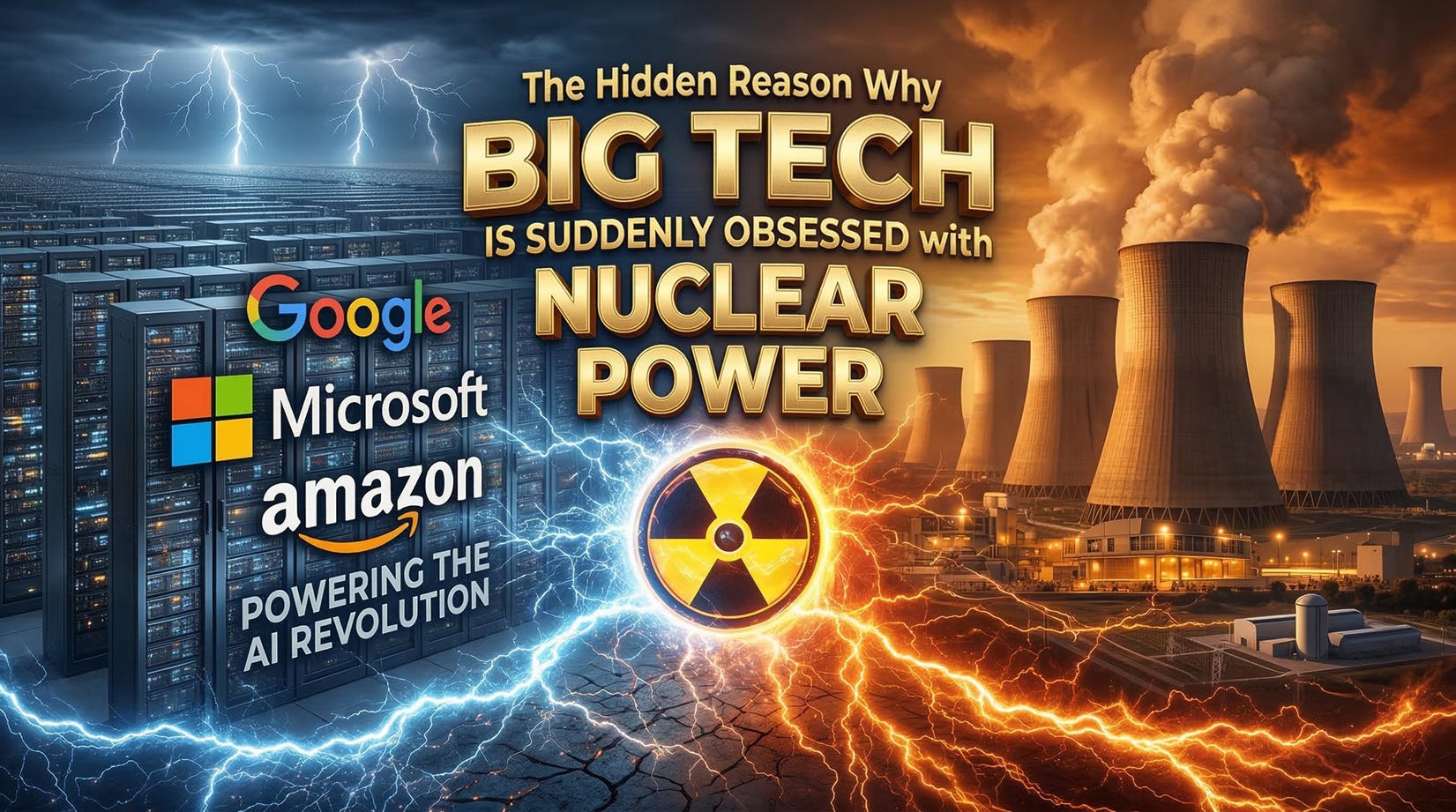
The Hidden Reason Why Big Tech is Suddenly Obsessed with Nuclear Power
To keep the "cloud" humming, companies like Microsoft and Google are making a controversial bet on nuclear restart projects and next-gen reactors.

Imagine you’re trying to run a marathon, but every time you pick up your pace, someone hands you a heavier backpack. That is precisely the dilemma facing the world’s largest tech companies today. They are racing to dominate the world of Artificial Intelligence, but the faster they go, the more energy they need and the traditional power grid is starting to groan under the weight.
For years, we’ve heard about the “cloud” as this ethereal, weightless thing. But in reality, the cloud is made of massive, hot, noisy warehouses filled with thousands of servers. These data centers are incredibly thirsty for electricity.
The Power Hunger
Last week, Microsoft made a headline that sounded like the plot of a sci‑fi novel: they are helping to restart a dormant nuclear reactor at Three Mile Island. Yes, that Three Mile Island.
They aren’t the only ones. Google and Amazon have also been busy signing massive deals to buy power from small modular reactors (SMRs). To the average observer, this seems like a massive U‑turn. Why is the industry that promised us a “paperless,” digital future suddenly tethering itself to the most controversial energy source of the 20th century?
The answer lies in a simple, cold reality: AI is an energy vampire.
Rewinding the Clock
To understand how we got here, we have to look at how data centers used to work. A decade ago, a data center mostly handled emails, stored photos, and hosted websites. These tasks were predictable. If you searched for a cat video on YouTube, the server didn’t have to “think”; it just had to find a file and send it to you.
Tech companies could easily offset this energy use by buying “Renewable Energy Credits.” They would build a wind farm in Iowa and claim their office in California was “green.” It was a neat accounting trick that worked well enough for the era of the smartphone.
But then came Generative AI.
When you ask ChatGPT to write a poem or a line of code, the computer isn’t just fetching a file. It is performing billions of complex calculations every second. This process generates massive amounts of heat and requires a constant, unwavering stream of high‑voltage power.
Suddenly, wind and solar which are “intermittent” (meaning they don’t work when the sun goes down or the wind stops) aren’t enough.
The 24/7 Problem
But here’s where the story gets interesting.
The tech giants have committed to being “Carbon Neutral” or “Carbon Negative.” This means they can’t just flip a switch and burn more coal or gas to power their AI dreams. They need a “baseload” power source something that stays on 24 hours a day, 365 days a year, without puffing carbon into the atmosphere.
In the world of clean energy, there is only one thing that fits that description at a massive scale: Nuclear.
Think of it this way: If solar power is a garden that grows only when the weather is nice, a nuclear reactor is a massive, underground battery that never runs out. For a company like Google, which cannot afford even a millisecond of downtime, that reliability is worth billions.
The Real Insight
Now you might wonder: why now? Why not five years ago?
The deeper truth is that we are witnessing the birth of “Sovereign Intelligence.” Big Tech has realized that the winner of the AI race won’t be the one with the best code, but the one with the most compute. And compute is just another word for electricity.
In the past, tech companies competed for eyeballs. Today, they are competing for atoms. By securing their own private nuclear power supplies, they are effectively “de‑risking” their future. They are making sure that even if the public power grid fails or energy prices skyrocket, their AI models will keep humming.
It’s a move toward “energy independence” for corporations. They are no longer just software companies; they are becoming their own utility providers.
The Broader Impact
What does this mean for the rest of us?
For consumers, it means AI might stay relatively cheap for a while longer, as companies find ways to keep operating costs stable. However, it also raises questions about whether these tech giants are “hogging” the cleanest and most reliable power, leaving the rest of the public with the more expensive, less reliable leftovers.
For investors, the message is clear: the AI trade is secretly an energy trade. The companies building the cooling systems, the copper wiring, and the nuclear components are the new “picks and shovels” of the gold rush.
For the economy, this could spark a “Nuclear Renaissance.” For decades, the nuclear industry was stagnant, bogged down by high costs and fear. Now, with the world’s richest companies writing blank checks for research, we might see a breakthrough in Small Modular Reactors that could eventually provide cheap, clean power for entire cities, not just data centers.
But here’s the twist: it’s a gamble. Nuclear projects are notorious for being over‑budget and years late. If these reactors don’t come online fast enough, the AI revolution might literally run out of steam.
We used to think the future of tech was all about bits and bytes. As it turns out, it might actually be about uranium and cooling towers.
And that’s why the world’s most modern companies are betting everything on the world’s most misunderstood technology.
Published in FirstScroll Daily